
Third Culture Family (TCF)
entry by Julie M. Marx, Global Family Expert at Expat Valley
A Third Culture Family (TCF) is a family unit whose shared identity, relationships, and daily life are formed in a “third culture” that emerges from sustained global mobility, rather than from any single passport culture or local host culture. TCFs may include couples with or without children, single parents with children, or other family constellations who live internationally over extended periods with no clear plan to return to one fixed “home” country. Their sense of belonging tends to be relational and transnational, anchored in people and recurring patterns of mobility more than in place, and family members often hold layered, in-between identities similar to those described in the Third Culture Kid (TCK) literature. TCFs frequently experience both significant strengths such as an expandable worldview, intercultural sensitivity, and multilingual repertoires and cumulative losses and ambiguous grief linked to repeated departures, repatriations, and changing communities. In practice, the TCF lens encourages professionals to consider the family as a whole system shaped by mobility, rather than focusing only on the globally mobile child or the assigned employee.
Comparable terms
Global nomad family (community and coaching usage, generally positive, emphasizes mobility and adventurous lifestyle rather than systemic impact); Cross-cultural family (clinical psychology and family studies, neutral, emphasizes ongoing interaction between distinct cultural frameworks within one family system); Internationally mobile family (HR/global mobility and destination services, neutral operational term, emphasizes relocation pattern and assignment context rather than identity); Expat family (community, HR, and relocation industry usage, mixed connotations, can imply privilege and expat–local power asymmetries, sometimes contested in critical mobility scholarship); Transnational family (migration and family sociology, neutral–analytic, emphasizes physical dispersion across countries and sustained cross-border family ties, not necessarily high-frequency relocation).
Why this matters
Including Third Culture Family as a term makes visible the reality that entire family systems, not just children, develop a shared third culture through long-term international mobility. It offers practitioners a precise, non-stigmatizing way to name the relational, identity, and transition patterns that emerge when families live across borders over many years. This term also bridges existing child-focused concepts like TCK and CCK with adult and systemic perspectives, supporting more integrated research, school practice, counseling, coaching, and HR policy. Finally, recognizing TCFs helps global mobility stakeholders design support that matches the lived complexity of mobile families, including educational continuity, family resilience, and wellbeing across multiple moves.
Cross-references
TCK (Identity & Belonging); ATCK (Identity & Belonging); CCK (Identity & Belonging); Global Nomad (Identity & Belonging); Hidden Immigrant (Identity & Belonging); Cultural Homelessness (Identity & Belonging); Relocation Cycle (Transitions & Mobility); Departure Cycle (Transitions & Mobility); Transition Fatigue (Transitions & Mobility); Cumulative Loss (Wellbeing & Mental Health); Ambiguous Loss (Wellbeing & Mental Health); Family Resilience (Family Dynamics). These entries together map the individual and systemic experience of globally mobile life: TCK, ATCK, CCK, Global Nomad, Hidden Immigrant, and Cultural Homelessness describe identity positions common within Third Culture Families; Relocation Cycle, Departure Cycle, and Transition Fatigue capture the repeated transition pattern many TCFs navigate; Cumulative Loss and Ambiguous Loss name the grief dynamics that can accumulate in mobile family systems; Family Resilience highlights the protective processes that enable TCFs to thrive despite ongoing change.
Sources
Pollock, D.C., Van Reken, R.E., Pollock, M.V. 2017. Third Culture Kids: Growing Up Among Worlds. 3rd ed. Nicholas Brealey Publishing. Vivero, V.N., Jenkins, S.R. 1999. Existential hazards of the multicultural individual: Defining and understanding cultural homelessness. Cultural Diversity and Ethnic Minority Psychology, 5(1), 6-26. Hoersting, R.C., Jenkins, S.R. 2011. No place to call home: Cultural homelessness, self-esteem and cross-cultural identities. International Journal of Intercultural Relations, 35(1), 17-30. Fail, H., Thompson, J., Walker, G. 2004. Belonging, identity and Third Culture Kids: Life histories of former international school students. Journal of Research in International Education, 3(3), 319-338. Globally Grounded. Third Culture Families: Redefining the traditional concept of home, family and friendship (De Spa’s TCF definition).
A two-tiered Family Support Program
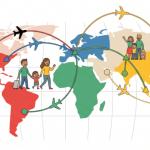 Client Profile Industry: Aviation & Aerospace Headquarters: USA Company Size: Global enterprise with over 100,000 employees worldwide Mobility Program Size: 10-49 international assignments/year Geographic Scope of Assignment Footprint: Global, with primary operational hubs and international corporate stations spanning the Americas, EMEA (Europe, Middle East, Africa), and APAC (Asia-Pacific). The Challenge:...
 Read more
Story 12 of 52 /// The memories so distant
 You were born in China, but you were only twenty months old when we repatriated. That time seems so long ago, the memories so distant. Literally. We moved back to the small town we came from, and rarely tell the stories of our international assignment as the experience is so...Read more
When ‘Home’ Is Two Places: How Global Families Decide Where Vacation Time Goes
 Rodrigo is planning the family’s summer vacation. What should feel fun and exciting is starting to feel like an exercise in frustration and self-doubt. Two years ago, he and Marcela moved with their sons, Benjamín and Tomás, from Chile to Calgary for Marcela’s job. Back then, the idea of living...Read more
Exploring the Decision to Live Apart
 “Is This Right for Us?” The opportunity came with just two weeks to decide. Marc had been offered a role he’d been working toward for years: regional director for his company’s Asia-Pacific operations. It was a career leap, complete with relocation support and a three-year contract in Singapore. But when...Read more
Beyond the Windmills: Read & Watch for True Dutch Insight
 Beyond the Windmills: Read & Watch for True Dutch Insight When you move to a new country, it’s easy to get stuck on the surface-level postcards of tulips, clogs, and picturesque canal houses. But to truly understand your new neighbors, you need to dig into the stories they share. You...Read more
Our Top 10 Global Family Favorites in the Netherlands
(And the Bargains to Get You There) To truly feel at home in the Netherlands, you need to master a vital cultural ritual: the hunt for a korting (discount). The Dutch absolutely love a good bargain, and honestly, why shouldn’t they? Exploring this beautiful country with your family is incredible,...Read moreNavigating Neurodiversity and Medical Complexity Abroad: Advocacy, Inclusion, and Support
 Introduction: The Unseen Layers of Global Mobility While the physical relocation of a family is complex in its own right, moving across borders with neurodiversity or medical complexity adds profound, often invisible layers to the journey. A core premise of this session was that individuals should not be excluded from...Read more
Story 2 of 52 /// After you hang up the phone, you decline the offer
 Imagine being a medical researcher from India, not just any, but the type that is at the stage of their career to lead medical breakthroughs. Now imagine receiving a phone call, a job offer to come work in the Netherlands for the most prestigious company in your field. The contract...Read more
Inclusion in Global Family Life
 Creating Belonging Across Difference On their first Monday morning in a new country, the Rahman-Lewis family arrived at the school gate carrying too many things. There were lunchboxes, water bottles, half-completed forms, a school bag that would not quite close, and a folder of documents that Maya had been told...Read more
Bridging the Social-Emotional Gap
 Designing a Culture of Care for School Transitions When the moving containers are finally unpacked, many organizations consider a relocation "complete." However, for the families at the center of these moves, the true work of grounding is just beginning. In our latest Roundtable for Experts & Educators, we moved beyond...Read more
1 2 3 … 5 Next »