
Q3 Family Care Check-In Insights Report
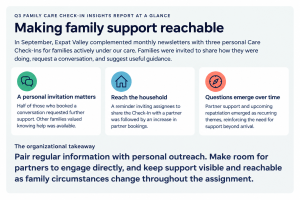
What proactive outreach reveals about the questions global families are carrying
Published 06-Oct-2026 by Karlijn Jacobs, Founder & CEO of Expat Valley
Continue reading for the full report or download the PDF here.
A family-support benefit is only useful when a family can find it, understand that it applies to them, and feel able to use it.
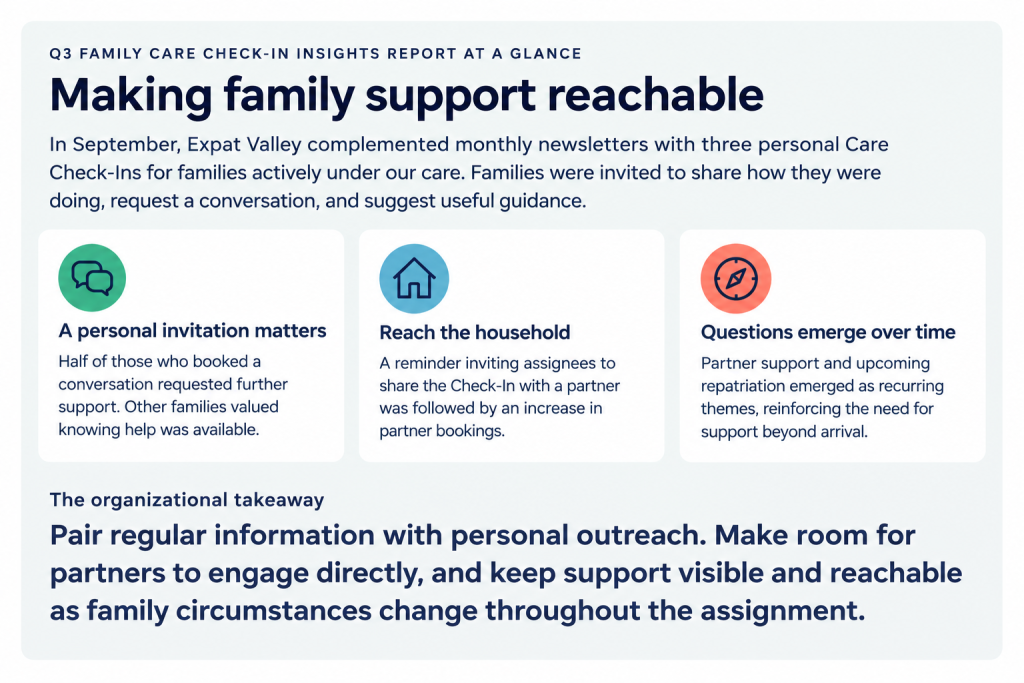
In Q3, Expat Valley combined regular monthly newsletters with a series of personal Family Care Check-Ins for families actively under our care. The purpose was simple: make it easier for families to say how they were doing, ask a question, book a conversation with a Global Family Expert, or tell us what guidance would be useful next.
The Check-Ins were short, personal messages. They were not designed as promotional emails or a replacement for regular resources. They were a direct invitation to be in touch before a family-related concern became an assignment risk.
This report shares the anonymized patterns emerging from that work, what they suggest for organizations supporting globally mobile families, and where Expat Valley will continue listening in Q4.
These insights reflect patterns from Expat Valley’s Q3 Family Care Check-Ins with families actively under our care. They are directional practice insights from our support work, not a representative survey of all global families.
A benefit only works when a family can reach it
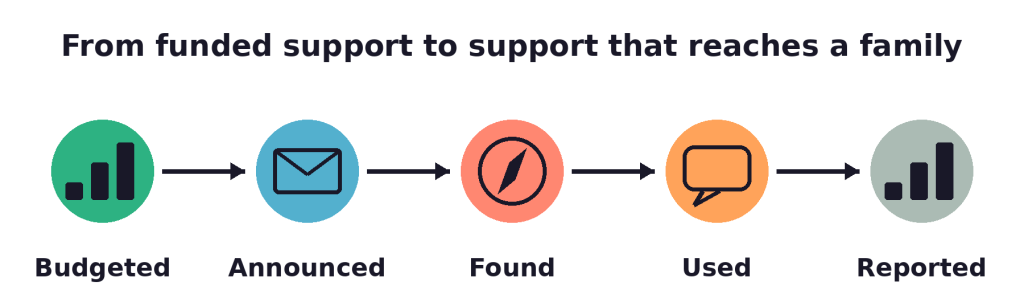
Most global mobility programs can show what support has been funded and what has been announced, often in the form of a global mobility policy that reflects benefits and allowances. The more difficult question is whether an assignee and their family knows what is available, recognizes that it applies to their situation, feels safe asking for it, and can take the next step when they need it.
Industry research suggests that this is a persistent gap. An example: more than half of HR decision-makers report providing travel-home costs and extended leave to see family, yet only two in five assignees know those options are available. In a separate 2026 global mobility study, only half of respondents felt family-support services were reaching families clearly enough for them to understand what was available and how to access it.
The wider benefits picture points in the same direction. Twenty-two percent of employees say they know little about the benefits available to them, while one in ten find their benefits too complex to use. Concerns about confidentiality and possible negative consequences can make it even harder for people to ask for help.
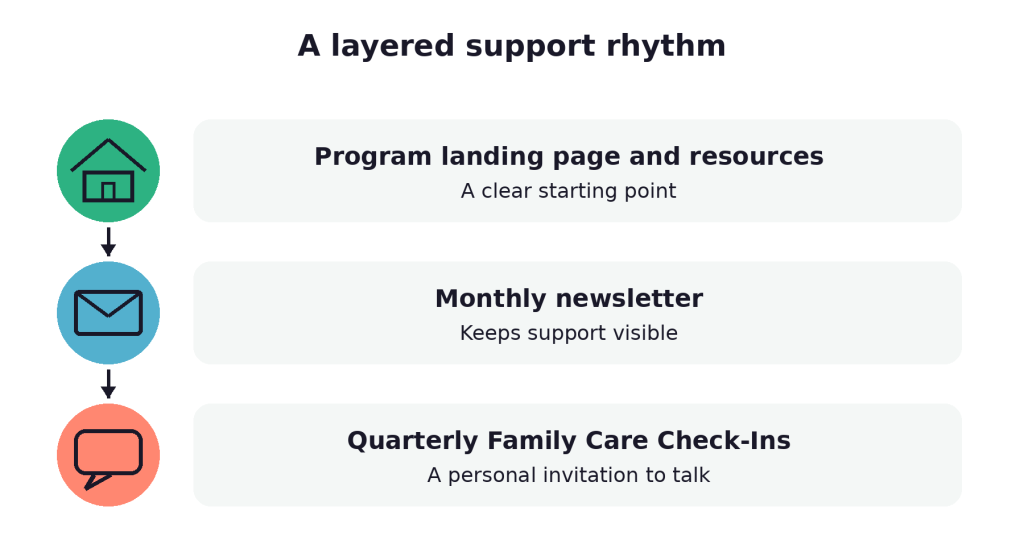
Expat Valley’s response is not to communicate harder about a generic list of benefits. It is to make support more reachable through a layered rhythm:
- A visible starting point through the relevant program landing page and resources.
- A monthly newsletter that keeps family support visible between moments of need.
- Quarterly Care Check-Ins that proactively invite families to share what is actually happening and make a next step easier to take.
What we did in Q3
During September, families actively under our care received three short, personalized Care Check-Ins. Each message invited recipients to:
- Reply and let us know how they were doing.
- Book a Global Family Hotline conversation if a question felt easier to discuss in person.
- Suggest topics they would like to see featured in future guidance.
The messages were intentionally concise and personal, with no designed campaign format and no links to a specific event. They were sent on September 1, September 16, and September 24.
Families who booked a conversation were removed from later messages. The goal was not to increase contact for its own sake. It was to offer a thoughtful, non-repetitive route into support.
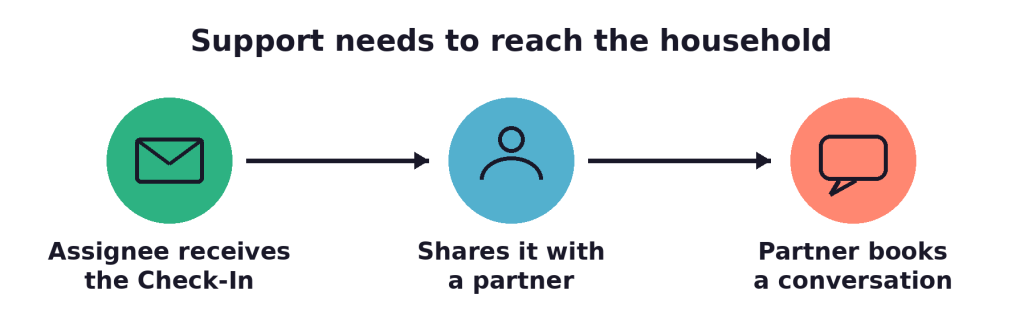
One reminder also explicitly encouraged the assignee to forward the message to a partner. Subsequently, we saw an immediate rise in conversations booked by partners.
What families told us
The questions raised through the Q3 Check-Ins were rarely only about a single practical task. They often sat beneath larger changes in identity, relationships, timing, family roles, and the next stage of life across borders.
Partner support
Partner support emerged as a recurring area of need. Families raised questions connected to partner wellbeing, the fit of available support, and the point at which a partner may need more than general guidance. This reinforces a central reality of global mobility: an assignment is experienced by a household, not only by the employee whose name appears on the contract.
Preparing for repatriation
Upcoming repatriation was another recurring theme. As one partner wrote, while sharing that they had just entered the last year of his wife’s international assignment:
“It is reassuring to know that support is available if needed.”
For families expecting to return later in the year, the questions had already begun. Repatriation planning is rarely only about a shipment date, school records, or a return flight. It can involve career continuity, children’s education, family relationships, identity, expectations of home, and uncertainty about what will feel familiar after a long time away.
The first step matters
Some families replied simply to say that they were doing well and appreciated being asked. Others used the message as encouragement to begin a conversation.
One family described feeling overwhelmed by everything happening around them and said that the Check-In encouraged them to book a conversation, even though they were not yet sure what to expect.
That is an important part of proactive family support. A family does not always need to arrive with a fully defined problem. Sometimes the first useful step is having permission to ask.
Early signals from two quarters of listening
Q2 and Q3 each used three personal Care Check-Ins to invite families to share concerns, request support, or book a conversation.
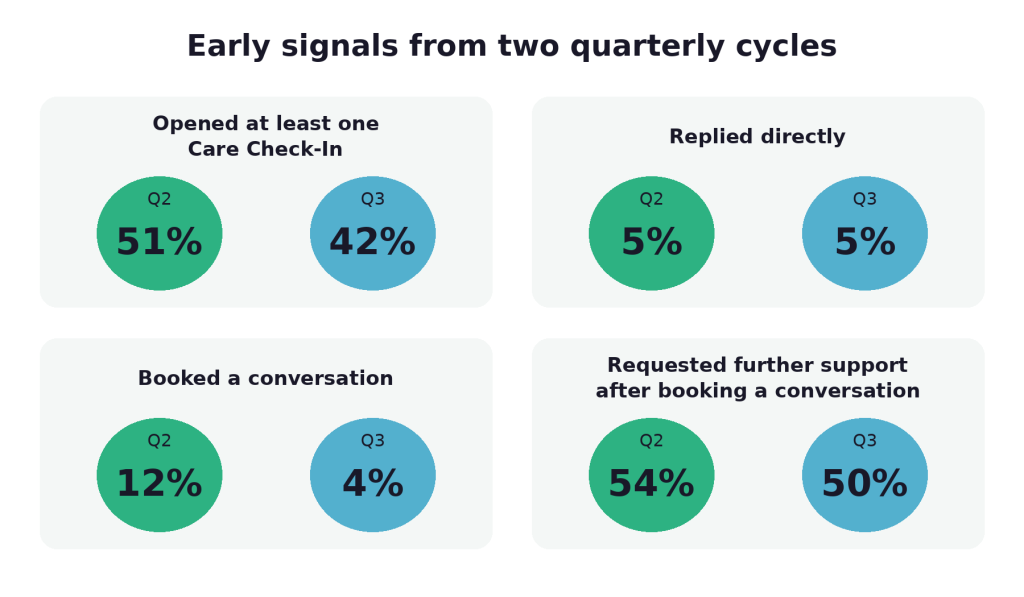
The Q2 and Q3 figures are early operational signals, not a conclusion about long-term trends. The first outreach cycle may naturally prompt more initial conversations, while families whose needs were addressed earlier may not need another call immediately.
What remained consistent was direct engagement. Families continued to respond to a personal invitation, and around half of booked conversations led to a request for further support.
Across both quarters, partner support and major family transitions remained visible themes. In Q2, families also raised questions around single parenting and education continuity.
What this suggests for global workforce employers
Family support is not a one-time benefit introduced at the start of an assignment. It needs to remain visible and reachable as family circumstances change throughout the assignment as a whole.
The Q3 Care Check-Ins reinforce five practical principles for Global Mobility, HR, and partner organizations:
- Do not wait for a family to identify its own crisis. Families under strain may not know what benefit applies, may not feel their concern is significant enough, or may not be comfortable asking their employer directly.
- Reach the household, not only the assignee. Partners, caregivers, and older children can experience a move differently. Their questions may not travel through the employee.
- Pair information with invitation. A newsletter can keep support visible. A personal check-in makes it easier for someone to respond when a question becomes real.
- Expect needs to emerge throughout the assignment. Questions may surface months after arrival, ahead of repatriation, during a change in family roles, or when a child’s or partner’s needs shift.
- Report patterns, not private stories. Organizations need a way to understand what families are raising without requiring families to disclose personal information to their employer. Aggregated, anonymized insight makes that possible.
Expat Valley’s model is designed around this activation cycle: support should not only be budgeted and announced. It should be found, used, and reported back through privacy-safe family insight.
What we will keep listening for in Q4
Q3 reinforced the importance of reaching families before a question becomes a crisis, and of leaving room for the concerns that may sit outside standard relocation conversations.
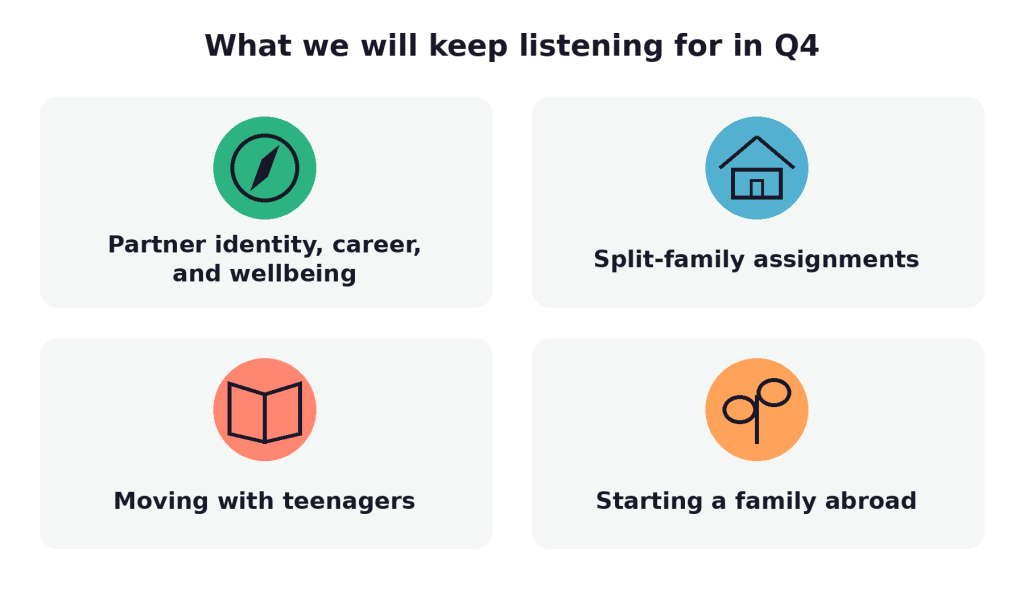
In Q4, Expat Valley will continue the Care Check-In rhythm alongside monthly newsletters and on-demand resources. We will pay particular attention to:
- Partner needs, identity, career, and wellbeing.
- Split-family assignments and the realities of family life across more than one location.
- Complex life stages, including moving with teenagers and starting a family abroad.
- Repatriation planning and the questions that can emerge well before a return move.
The aim is not to predict what every family will need. It is to make support easier to find, easier to trust, and easier to use when the question becomes real.
Build a more reachable family-support program
Are you looking at how your organization supports global families in practice?
A Global Family Strategy Session with Karlijn Jacobs is a focused conversation about your current program, your family population, and where support may be getting lost between policy and use.
Book a Consultation with Karlijn Jacobs.
Want to experience the support available to families firsthand?
Request complimentary Guidebook access to experience global family support for yourself: the Global Family Library, live and recorded Global Family Webinars, and practical guidance pathways.
Request Complimentary Guidebook Access.
« Back