
Family-friendly mobility policies

Making international opportunities work for your talent
An international role may be a career opportunity for one person, but it changes life for the whole family. A partner may be questioning their professional identity. Parents may be navigating their child’s adjustment while managing their own. Education choices, changing relationships, and wellbeing all influence whether the move feels possible, and whether it continues to work.
For employers, these questions connect directly to attracting talent, improving the employee experience, and retaining people. Family-friendly mobility policies bring those organizational priorities together with the realities of Relationships, Education, Parenting, Career, and Wellbeing.
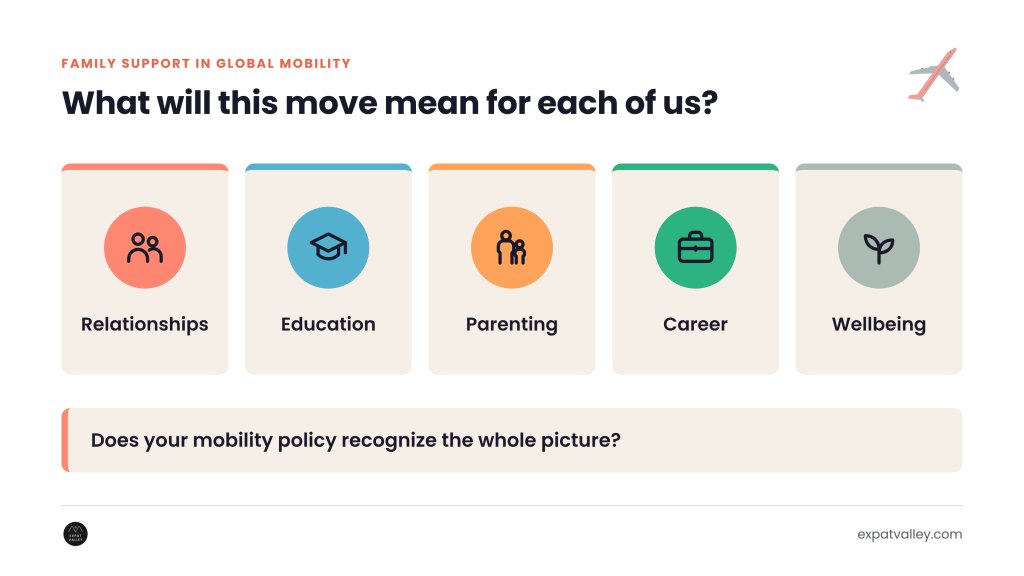
In our recent webinar, Family-Friendly Mobility Policies, we explored how to strengthen that connection. The starting point was not “What benefit should we add?” but “Does the support we offer work for the families it is designed to help?”
Five ways to make your policy work harder
1. Start with your organization’s objective
If talent attraction is the priority, families need to understand the opportunity, how it will impact their lives, and available support before the employee accepts. If employee experience matters most, support should be clear and easy to access. If retention is the goal, it needs to remain relevant when family circumstances change long after arrival.
The outcome you want should shape who is included, when support begins, and how long it lasts.
2. Recognize the families you actually employ
Female-led assignments, single parents, dual-career couples, blended families, and households living across locations can expose assumptions in policies built around a traditional family model.
Review who your policy recognizes and what it assumes about whose career takes priority, who carries parenting responsibilities, and whether everyone moves together. Clear definitions help families understand where they fit before an unanswered question becomes a problem.
3. Match support to when families need it
A partner may focus first on their children’s adjustment and only later have space to consider their own career. If career support expires before that point, the benefit and the family’s needs never meet. Extending the support window can make the existing provision more useful without increasing its value.
Education support also needs to reflect the family’s circumstances, including location, school stage, and continuity. A carefully researched cap can preserve access to suitable, quality education while reducing expenditure by excluding the most expensive, top-tier options from standard coverage. A clear exception route remains important where a child’s needs cannot be met within the cap.
Family-friendly policy design can mean better timing and more intentional boundaries, and cost-savings on one benefit could be applied to more value-based support.
4. Give family support its own place in the policy
Family-related provisions are often scattered across education, partner support, home leave, insurance, and allowances. Bringing them together in a dedicated chapter helps families understand what is available, when it applies, and how to access it.
To make that practical, we developed three example family-support chapters: for international assignments, permanent transfers and international hires, and families living across locations. Each reflects a different context. They are starting points to adapt, not policies to copy unchanged. A Strategy Consultation provides an opportunity to explore the relevant examples in the context of your own organization.
5. Understand the family’s needs, then address the gaps
A clear policy cannot tell you what a particular family needs. That requires a conversation.
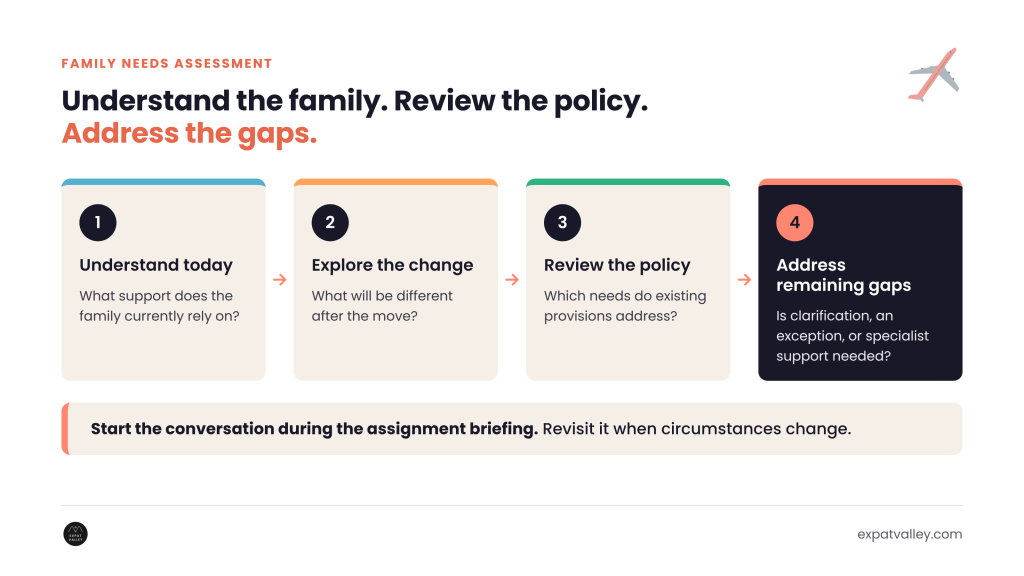
A family needs assessment, for example during the assignment briefing, helps Global Mobility understand the situation today, what will change after the move, what the policy provides, and what remains uncovered. This is especially important in special family circumstances, such as additional educational or care needs, health considerations, or the loss of an established support network.
GM’s responsibility is not to diagnose or collect sensitive personal details. It is to understand support needs, explain the available provisions, and establish what happens when gaps remain. That may mean clarifying an existing benefit, considering a reasoned exception, or involving confidential specialist support.
Explore the approach in the on-demand webinar
A more family-friendly policy does not necessarily require a larger budget. It requires a clearer connection between what families need and what your organization wants its mobility program to achieve. Register for Family-Friendly Mobility Policies on demand to explore practical cases, policy-design choices, and questions you can use to review your own approach.
Register for the on-demand webinar
Apply the insights to your organization
Book a Strategy Consultation to discuss your priorities, explore our example family-support chapters, and identify where clearer provisions or a different approach could help your policy work better.
« Back