
The Hidden Hurdles in Global Family Life

And why we were never meant to solve them alone
When we think about international relocation, it is easy to focus on what can be planned, measured, and managed such as visas, housing, schools, and logistics. These are the visible layers, the ones we can organise and prepare for with a sense of control.
But when we recently brought together a group of professionals working closely with global families, it confirmed what we’ve known for a long time. The most significant challenges are not found in those visible layers. They sit beneath them, shaping the experience in ways that are often harder to name and therefore easier to overlook.
Where this conversation began
Our first Expat Valley Roundtable for Experts & Educators brought together educators, relocation specialists, coaches, and mental health professionals from across continents. Each came with their own lens and daily experience of supporting families navigating life across borders.
This was not a spontaneous moment. The Roundtable had been months in the making, shaped by ongoing conversations, shared observations, and a growing sense that something was missing in how we collectively support global families. Even so, the level of connection in the room went beyond what we expected.
What surfaced was not just a collection of perspectives, but a shared recognition. We are all seeing similar patterns, and they are more human, more complex, and more interconnected than the systems around them are currently designed to support.
Why this space matters
This Roundtable is the first of a monthly series designed to bring together those working with global families, not only to exchange perspectives, but to better understand what already exists, where the gaps are, and what we might begin to build together.
Because the reality is this. No single person, profession, or organisation holds the full picture of global family life. And yet, families experience it as one continuous, interconnected whole, where each decision and each challenge affects the next.
As one participant shared during the session, “Families are often treated as service recipients rather than partners in shaping their own experience.” That gap between what is offered and what is actually lived is often where the hidden hurdles begin to take shape.
What we’re starting to see more clearly
As the conversation unfolded, certain themes came up again and again, not as isolated observations, but as patterns cutting across roles, geographies, and contexts.
We often try to define the “hardest” stage of relocation, whether it is the departure, the first year, or the return. In reality, the experience does not follow a neat or predictable timeline. Each phase brings its own set of challenges, shaped by life stage, expectations, and what unfolds along the way. What feels manageable at the beginning can become more complex later, particularly once the initial momentum settles and everyday life takes over. As one voice put it, “The first year feels exciting, so you don’t mind the hurdles. It is later that it gets tricky.” Relocation is therefore not a single transition, but an evolving process of adaptation.
A related theme that surfaced consistently was misalignment between partners, between parents and children, between expectations and reality, and between what organisations promise and what families actually encounter. These misalignments are rarely dramatic. More often, they build gradually through small frustrations, unspoken assumptions, and decisions made without full clarity. Over time, however, they can come to shape the overall experience in significant ways. As one participant put it, “If you don’t have an aligned vision at the start, everything after becomes a hurdle.”
Alongside this, the emotional and relational dimensions of relocation remain under-addressed. Despite years of progress in global mobility, grief, identity shifts, loss of belonging, and changes in roles and relationships are still not consistently integrated into how families are prepared and supported. These are not side effects of relocation. They are central to it. And yet, they are often only acknowledged once challenges have already surfaced, rather than being part of the conversation from the beginning. As one participant reflected, “Happiness and grief can live side by side.”
This connects closely to another pattern. Support is often reactive rather than proactive. Many families do receive support, but it tends to arrive after something has already started to feel difficult. By that point, the experience has already been internalised in a particular way. If everything was supposed to be taken care of, then any struggle can begin to feel personal, like a failure to adapt or a lack of resilience, rather than a natural response to a complex transition. As one participant noted, “Internalising these challenges often happens when support is missing.” When support is not visible early on, people can begin to assume they should not need it at all.
At the same time, while information is more accessible than ever, it does not necessarily translate into understanding and lived experience. Families can research school systems, healthcare options, and cultural differences well before arrival, but knowing what exists is not the same as knowing what is right for your family. Understanding how a system works does not automatically lead to confidence in navigating it. What many families are missing is not data, but interpretation, context, and the reassurance needed to make decisions that feel aligned with their situation.
The layers we don’t always see
As the conversation deepened, another dimension became more visible. Not all challenges are shared openly. Some remain unspoken within individuals, within relationships, and within identities that are still evolving or not yet fully understood, even within the family itself.
A child quietly questioning where they belong, a partner gradually losing a sense of self, or a parent holding everything together while feeling increasingly isolated are experiences that do not always surface in practical conversations, yet they shape the overall journey in profound ways.
Families make decisions based on what they know, but not everything that matters is always visible or voiced. These unseen layers often influence the relocation experience more than any logistical factor, and yet they are the ones least accounted for in formal systems of support.
A shared reality across systems
One of the most important realisations from the Roundtable was that the challenges global families face do not belong to one single domain. They sit at the intersection of education, relocation, mental health, identity, and family systems, which has practical implications for how support is designed and delivered.
For example, a successful school transition is not just a responsibility of the school, just as family wellbeing is not solely the responsibility of the family. A successful assignment cannot be defined by logistics alone. Each system holds part of the picture, but no single system holds the whole. When those pieces are not connected, families are often left to bridge the gaps themselves, carrying a level of complexity that is rarely acknowledged. Our second Roundtable is a deep-dive into this specific topic: International School Transitions. You can find more information and registration here.
What this opens up
What we saw in this first Roundtable was not just insight, but momentum. Ideas began to form around how to better integrate emotional and relational support earlier in the relocation journey, how to provide clearer guidance before arrival, and how to develop a shared language to describe these experiences more accurately. Participants were encouraged to pitch (new) projects for future collaboration, three initiatives were presented:
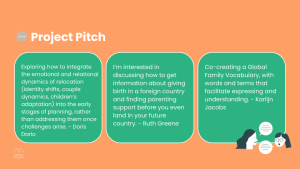
These are not fully formed solutions, but they represent important starting points. Many of the answers already exist in fragments across different people, organisations, and sectors. What is needed now is not only connection, but the ability to translate that connection into meaningful, positive shifts in how the global family ecosystem functions as a whole.
Each project received positive response from the participants in the audience. We are continuing conversations with Doris and Ruth on how/where to start their projects. In the meantime, all participants and you as our reader are warmly invited to contribute to the Global Family Vocabulary by completing this form.
An invitation
Global mobility is often framed as a logistical journey, but for families it is a lived experience that touches identity, relationships, wellbeing, and belonging all at once. Supporting that experience well requires more than expertise in one area. It requires connection across disciplines, perspectives, and lived experiences.
This is what we are beginning to build through these Roundtables. If your work touches global families in any way, we invite you to be part of the conversation, not just to listen, but to contribute to something that is still taking shape.
Because no one supporting global families should have to do it alone, and neither should the families themselves.
« Back