
A Strong School Year Start for Global Families
How to understand the hidden rules, changing routines and everyday surprises of school across borders
The school year is underway. The morning routine may already be taking shape, school messages may be arriving through an unfamiliar app, and your child may already have opinions about lunch, homework, classmates or the journey to school.
Yet for many global families, the questions begin once the school day becomes real.
“What are we expected to know about this school year that nobody has actually explained to us?”
Starting school across borders can involve more than a new building, timetable or curriculum. Families may be learning unfamiliar expectations around grading, homework, parent communication, classroom behaviour, school routines, language and belonging, all while their children are already living the school day.
The good news is that you do not need to understand an entire education system at once. Start by noticing what feels unclear, ask the next useful question, and create a few steady routines at home while your family learns the terrain together.
This article follows one fictional global family. Their story may not look exactly like yours, but the questions will be familiar whether your child attends a local, public, private, bilingual or international school.
School is familiar. School systems are not.
By the third week of term, the Santos-Khan family had learned the route to school, the right entrance and the timing of afternoon pick-up.
Leila and Tomas had moved with their children, Maya, 10, and Leo, 6, from São Paulo to Brussels. They had found school places, completed the forms and gathered the supplies their children needed. Maya had already met another child who liked the same books she did. Leo knew his teacher’s name and had started using French words at home.
From the outside, the school year had started well.
But at breakfast, the questions were beginning to pile up.
Maya was trying to work out which tasks in the school app counted as homework and which were optional. Leo had learned that some snacks seemed more common at school than others. Leila was reading a message from a teacher and wondering whether she was expected to reply. Tomas had seen an invitation to a school meeting but could not tell whether it was an obligation, an opportunity, or simply information.
None of these questions seemed serious on their own. Together, they revealed something important: a school is not only a place where children learn. It is also a system of spoken and unspoken rules.
Learning and success can look different
Children everywhere learn, receive feedback and complete work outside school. But the expectations around those things can vary widely.
A new school year may bring different ideas about:
- How independently children are expected to manage homework.
- What counts as participation in class.
- Whether speaking up, careful listening, accuracy, creativity, collaboration or competition is most visibly rewarded.
- How grades, feedback and progress reports are presented.
- When parents should step in, and when a child is expected to find their own way.
Maya’s feedback felt less direct than her parents were used to. Her teacher spoke about participation, collaboration and independent learning. Tomas assumed that sounded positive. Maya was less sure. She did not yet understand what those ideas looked like during a normal day in her classroom.
The point was not that the school’s approach was better or worse than the one the family knew. It was that Maya was learning what success meant in this setting while already being asked to work towards it.
Parent-school communication has its own culture
Leila’s uncertainty about the school app is familiar to many internationally mobile parents. Schools differ not only in what they communicate, but in how they expect families to respond.
In some settings, parents are encouraged to ask questions early and often. In others, teachers may prefer to communicate through formal meetings, designated contacts or a particular online channel. Some schools expect parents to be highly involved in classroom activities and homework. Others see a more hands-off approach as part of supporting a child’s independence.
Instead of trying to guess the right approach, ask the school how it prefers to work with families.
A short, respectful question can save weeks of uncertainty:
- “What is the best way to contact you if we have a short question?”
- “Who should we speak to about practical issues, language support or wellbeing?”
- “What would you prefer parents to raise early rather than wait on?”
- “When are the best opportunities to talk about how our child is settling in?”
Parents and schools see different parts of a child’s experience. School staff see the classroom, breaks and peer interactions during the day. Parents often see the effort it takes to manage those experiences once their child comes home. Staying connected can help everyone build a fuller picture.journals.sagepub+1
When a small detail becomes a big question
For Maya, the hardest moments were not always academic.
One afternoon, she came home frustrated after a group assignment. Her classmates had moved quickly into groups, speaking French as they organised themselves. Nobody had deliberately excluded her, but Maya did not know how to enter the conversation.
“I know what I have to do,” she told Leila. “I just do not know how everyone else knows what to do.”
That is a familiar experience for many Global Kids. They may understand the lesson while still learning the social shortcuts, language rhythms and classroom expectations that other children already know.
A child can cope with the school day and still be working very hard to understand how it works.
This is why “How was school?” does not always lead to much conversation. A child who has spent the day concentrating, translating, observing or trying to get unfamiliar rules right may only have the energy to say, “Fine.”
The Santos-Khan family began asking about moments instead:
- “What was the easiest part of today?”
- “What took the most energy?”
- “What did other children seem to know already?”
- “What is one thing you wish someone had explained?”
- “What became a little easier this week?”
These questions do not require children to report on their whole day. They give them a way to name one experience.
They can also help parents notice patterns. Is the difficult part the classroom, lunch, school transport, breaks, homework, language, friendship or the journey home? Is there a person, place, activity or routine that helps the child feel more like themselves?
Build a school-year map
One evening, the Santos-Khan family opened a shared note and called it: Things We Are Still Learning About School.
Maya added: “How grades work?”
Leo added: “Which snacks are okay?”
Leila added: “Who to ask about the school app and calendar?”
Tomas added: “What parents are expected to do with homework?”
The list did not solve the questions. It made them visible.
A school-year map is a simple way to turn general uncertainty into practical questions your family can answer one at a time. It is not another task to complete perfectly. It is a shared working document that can change as the school year unfolds.
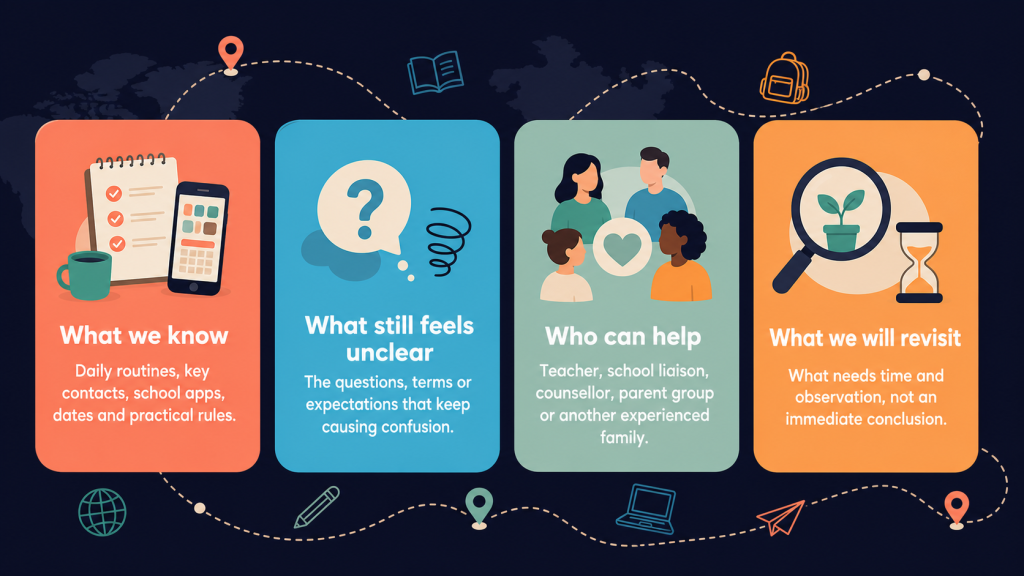
The goal is not to understand the whole education system in one month.
Instead, ask:
Which answer would make this week easier for our family?
For Maya, it was understanding what classroom participation looked like. For Leo, it was gaining confidence with the rhythm of the day. For Leila and Tomas, it was learning who to contact and what questions to ask.
The same tool can help families who have lived abroad for years. A new teacher, school phase, curriculum, language level or developmental stage can bring new questions, even when the country itself no longer feels new.
Keep some things steady at home
The Santos-Khans could not make school feel identical to the one they had left behind. Nor did they want to. Their children were beginning to build lives in a new place.
But they could make home feel steady enough to support the work of adjusting.
They chose two small routines:
- Everyone had 20 minutes to arrive home before questions, homework or logistics began.
- On Friday evenings, the family shared one thing that had become easier and one thing that still felt strange.
For Maya, that created room to mention a difficult group-work moment without feeling that it needed to be fixed immediately. For Leo, it gave him space to practise a classroom phrase or talk about a new playground game. For Leila and Tomas, it revealed that their children needed different kinds of support.
These are portable routines: small family practices that travel with you, even when the school timetable, language and culture around you have changed.
Your family’s portable routines might include:
- A familiar after-school snack, walk, song, conversation or quiet moment.
- A weekly practical check-in for school messages, diary dates, supplies and activities.
- A predictable homework rhythm that works for your family.
- One question at the end of the week: “What became more familiar this week?”
- An agreement that a difficult school day does not always need to be solved before bedtime.
Portable routines are not about holding on to the country you left. They give children and parents enough continuity to recover from the effort of adapting and to meet the unfamiliar with more energy.
Ask early and ask specifically
Leila drafted a message to Maya’s teacher several times before sending it. She did not want to seem demanding. She also did not want to wait until a small uncertainty had become a bigger frustration.
Eventually, she asked for a short check-in. She did not ask the teacher to explain everything about the school system. She asked a few focused questions:
- “How is Maya managing group work and classroom participation?”
- “What does progress look like at this point in the term?”
- “What is the preferred way for parents to raise a short question?”
- “Who should we contact if we have a question about language support or wellbeing?”
- “Is there one thing you would recommend we focus on at home, if anything?”
The conversation helped the family see that Maya was managing more than they had realised, while still needing time and encouragement to enter group conversations in French.
Asking early and specifically is not the same as demanding an immediate solution. It is one way families and schools learn how to support a child together.
If you are unsure where to begin, choose one question from the school-year map. The best first conversation is usually the one that helps the school understand something concrete about your child’s experience.
A layered answer can still be honest
One afternoon, Maya mentioned that another child had asked where she was from.
It was a simple question. But Maya had lived in Brazil, was now living in Belgium, spoke Portuguese and English at home, and was learning French at school. The answer did not fit neatly into one word.
For many Global Kids, questions about home, language and identity are more layered than classmates realise.
The Santos-Khans talked about having different ways to answer:
- A short version for a quick conversation.
- A longer version when someone is genuinely interested.
- Permission not to explain everything to everyone.
The aim is not to give a child a perfect script. It is to give them choice.
Belonging does not require a child to compress a layered life into one easy answer.
The Global Family Vocabulary can help families explore language around global family life, including terms such as Cross-Cultural Kid, Third Culture Kid, acculturation and identity.
A school year is a season, not a verdict
By the end of the first month, the Santos-Khan family had not solved every school question.
Maya still found some group-work moments difficult. Leo still came home tired on days when the new routine had taken more energy. Leila still reread school messages before replying. Tomas still had questions about homework and parent involvement.
But they no longer treated every uncertainty as evidence that something was going wrong.
They had a map, a few routines and a clearer sense of who to ask. Most importantly, they had stopped expecting themselves to know everything already.
Settling into a school year abroad is not a single moment at the school gate. It is a process of learning the terrain together.
The goal is not to master every rule immediately. It is to notice what matters, ask the next useful question and give every family member more room to feel capable, included and increasingly at home.
Continue the conversation
The practical questions are only one part of the school-year experience. In our live Global Family Webinar, The School Year Has Started. Now What?, Karlijn Jacobs and Global Family Expert Julie Marx will explore what can sit beneath them: belonging, identity, parent-child differences, the effort of adapting and the next steps that can help a family find its footing.
The session is included with the Guidebook Plan, alongside the Global Family Library and every webinar recording. Existing Guidebook members can register through the My Expat Valley portal.
If your family is carrying a bigger question about school, relocation or wellbeing, you can also book a free 15-minute Family Support Discovery Call with a Global Family Expert.
« Back