
From pain points to policy: mapping the family journey for global talent success
This article is a recap of the workshop delivered by Karlijn Jacobs, Founder of Expat Valley, at the RES Connect event in London on December 3rd, 2025. The event was themed “Re-humanizing Global Mobility.” Participants included HR and Global Mobility industry leaders, both in-house professionals as service providers.
The theme of Re-humanizing Global Mobility hits home for Expat Valley. Research shows that the international assignee’s partner and children form great risks to both assignment uptake and completion, yet their needs and wellbeing are often overlooked.
I witnessed this disparity both personally and professionally. While my own international relocation began with 6-12 months of ongoing conversation, where my name and family were known and supported, today’s landscape is dramatically different.
The Global Mobility Time Crunch
The current environment places most Global Mobility professionals and teams under immense strain, swamped with paperwork and bureaucracy. The combined call for “budget consciousness” and the focus on AI and technology is meant to address these challenges.
The irony is that while technology streamlines immigration procedures, it risks depersonalizing the core relationship. The current organizational reality means relocations are pushed to happen as soon as possible. More often than not, when I ask “How many children has your organization relocated in the last 12 months?” the answer is not readily available. It is exceptional when global mobility managers know the names, ages, and worries of the children of their colleagues.
Consequently, Global Mobility Policies are no longer fit for purpose, often rooted in design for executive relocations, traditional family units, and more abundant time availability and GM involvement.
The Strategic Shift: From Research to Action
One of my favorite workshops is our Quickscan, which we apply when supporting organizations with making their global mobility programs more family friendly. This strategic workshop moves you past the paperwork bottleneck by defining your focus areas for family-friendly relocation and thus greater international assignment success in one session.
We start by reviewing research that supports the importance of caring for family needs and wellbeing, helping GM and HR leaders determine what is most relevant for their business targets, culture, and risk management. However, research paints an abstract picture only; it doesn’t explain whý the family factor is such a great risk, nor does it give handholds for effective support.
Which is why the second stage of the workshop is teaching participants about the defining moments and emotional rollercoaster that make up the Family Relocation Experience. For the RES Connect workshop, we focused solely on the Global Talent Onboarding stage (or from the assignee/family perspective: their Pre-departure and Settling-in stages).
The Family Journey: From Honeymoon to Culture Shock
This contrast is stark: While my own assignment took 6-12 months to finalize, today’s business demands mean families often have only 6-8 weeks between signing a contract and the actual move. This lack of sufficient time to prepare is a critical assignment breakdown point.
From the Assignee & Family-perspective, the Pre-departure stage is signified by very little time, an emotional mix of excitement and grief, and a long to-do-list. Typically, the assignee is wrapping up their old job and preparing for the new one simultaneously.
The Set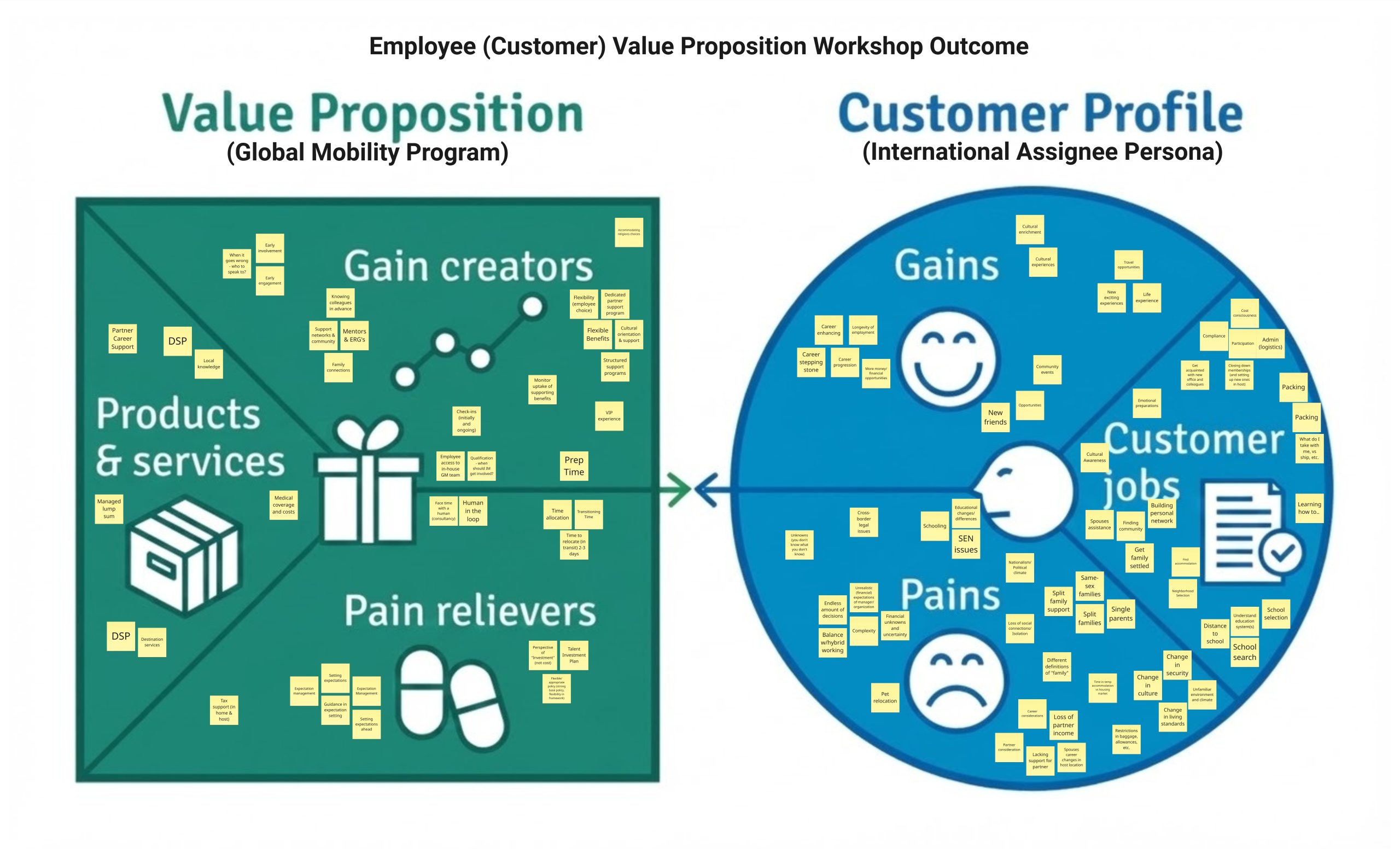 tling-in stage often starts with a honeymoon period, but quickly gives way to culture shock. Unmanaged, this period of heightened negative emotions and uncertainty forms a potential assignment breakdown point.
After a theoretical crash course, participants were invited to work through the Customer Value Proposition Canvas (originally developed by Strategyzer): envisioning the International Assignee as the Customer of their Global Mobility program (the Value Proposition). In small groups, participants explored the Gains, Pains, and Jobs-to-get-done of an international assignee during Onboarding, before brainstorming solutions. Their ideas and best practices are shared in the image (click for larger version).
Five Key Findings for Family-friendly Policy
To highlight the strategic takeaways from the workshop:
- Educate to Elevate: It is important to keep in mind that one “doesn’t know what they don’t know.” Providing your future colleagues with reliable information, including highlighting the positive impact of life abroad on career and family future, combined with expectation management improves assignment uptake and success.
- Advocate for Time: We should acknowledge that business demands for new international assignees to be on the job as fast as possible goes at the cost of those people having sufficient time to prepare. Global Mobility should advocate on the assignees’ behalf with the business: for more time or more support. Our Family Relocation Risk Assessment can support this advocacy.
- The Human Element is Non-Negotiable: Workshop participants highlighted the importance of real human involvement in assignment management. They indicated that while technology could streamline processes and alleviate bureaucratic matters, it takes a real human being to consult and empathize the assignee and protect the business’ investment into the international assignment. This human involvement doesn’t require GM to bear the entire burden; it means providing focused, empathetic acknowledgment that validates the family’s journey, which is often the most critical intervention.
- Policy must Reflect Reality: The traditional family unit, with one working- and one stay-at-home parent, is a rare find these days. Global Mobility policies need to be designed considering dual careers, single parents, same-sex couples, blended families, adopted children, elderly parents, and other family compositions.
- Acknowledge Split-Family Complexity: Perhaps as a consequence of all of the above, many groups highlighted the rise of split-family assignments. Research indicates that the split-family approach brings its own unique set of challenges and should not be treated as less impactful than a full family move.
I felt sorry for having to break up conversations after an hour, as it was clear there was much more energy and ideas to share amongst participants. Thankfully the event offered much more relevant insights: Christelle Labbe, board member for the Permits Foundation, kicked off the panel discussion by sharing insights from their survey on the human impact of (lack of) partner employment.
Continue the Conversation
Ready to translate these insights into actionable policy changes at your organization?
We are more than happy to continue this conversation in the context of a tailored Quickscan workshop at your company. This is the first step in moving your team from managing bureaucracy to driving strategic talent success.
- Request more information about the Family-friendly Relocation Quickscan Workshop here.
- Don’t miss our next session: Expat Valley kicks off 2026 with a strong focus on successfully managing split-family assignments. Follow this link to register for a webinar hosted by David Enser (The RES Forum) and Karlijn Jacobs (Expat Valley) on the topic.
« Back