
Ties That Stretch, Ties That Hold: One Family’s Journey Through Friendship After Relocation
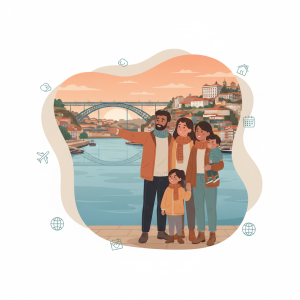
A story of continuity, change, and connection across borders
In Timișoara, the Mihai family lived a life stitched together by familiarity. They had their rhythms, with school runs, Sunday lunches with extended family, and impromptu visits from neighbors. Their connections were not just social, they were embedded. Known. Assumed.
When Marius was offered a new role in Porto, it felt like both a leap and an opportunity. He had worked in logistics for years, but this would be the first time his work took him abroad. Anca, a schoolteacher and natural community-builder, was intrigued by the idea of a slower lifestyle by the sea. Their children, Ana and Vlad, were more hesitant. They had never known anything but their neighborhood in Timișoara. Their roots were deep.
Still, the family decided to go, open-hearted and nervous. The final weeks were a swirl of goodbyes, packing tape, and promises to stay in touch. At their farewell gathering, Ana clung to her best friend, Bianca. Vlad’s classmates gave him a hand-drawn book of memories. Everyone said, “It’s not goodbye. Just see you later.”
But even before the plane lifted off, something had shifted. Not a clean break, but a slow unraveling of the social fabric that had once held them so tightly. A subtle ache began to form, the kind that shows up when part of your heart is in one place and the rest is trying to settle somewhere new.
The Quiet Gap
Porto welcomed them with sun, sea, and a deep silence.
The first few weeks were full of logistics. Forms, furniture, and school registrations kept them busy. But when the errands slowed, the emptiness surfaced.
There were no spontaneous visits from neighbors, no shared history with the parents at school pickup, no one to meet for coffee who already knew their story.
Ana found herself eating lunch alone, scrolling through her phone, waiting for messages that stopped coming. The group chats from Romania had gone quiet. Vlad, once confident and chatty, shrank into himself in the classroom. His jokes did not land. The other kids played differently. He missed being known.
Anca, who had once felt so anchored in her local community, now stood on the edges of parent circles. The other mothers were friendly but already woven together. She could not find her way in.
Marius was swamped at work, but underneath the busyness was something quieter. He missed his best friend, Radu. It had been nearly a month since they last spoke.
One evening, Ana said it aloud. “I feel like part of me is still in Romania.” No one disagreed.
So Anca began a small ritual. Once a week at dinner, they lit a candle and named someone they missed. It was a way to acknowledge the people still holding space in their lives, even from far away.
Little Openings
Slowly, gently, things began to shift.
Ana was paired with a Portuguese student, Leonor, for a school mural project. At first, they barely spoke. But as the paint flowed, so did the conversation. One afternoon, Leonor invited her to a picnic. Ana almost said no. But she went.
Vlad’s teacher noticed him standing alone during recess. She asked if he would be willing to start a football game. Being the captain gave him a role. Kids began to join in. One even asked to come over after school. That evening, Vlad could not stop smiling.
Anca joined a yoga class by the river. After one session, a British expat introduced herself and invited Anca to a WhatsApp group for international parents. It was not instant belonging, but it was a step.
And one night, after a hard day, Marius got on his bike, rode to the ocean, and called Radu. They spoke for nearly two hours. Nothing dramatic. Just life. It grounded him.
None of these moments were big or dramatic. But they opened something. They softened the silence. They reminded the family that connection could return, just in unfamiliar forms.
Weaving Old and New
By spring, their social map was beginning to redraw itself.
Ana created a group chat with Leonor and two classmates. One day, she invited them to join a video call with her friends in Romania. She said it felt weird and wonderful to have both parts of her life on one screen.
Vlad hosted a birthday party in the park. Three classmates came. They sang Happy Birthday in two languages. Later that night, he asked to send a video to his old class to show them his new football friends.
Anca hosted a brunch, baking Romanian pastries and inviting both expat moms and a Portuguese neighbor. They shared stories about raising kids far from home. She left the table with a full heart.
Marius joined a Saturday cycling group. He did not say much at first, but after a few rides, someone invited him for a post-ride beer. He said yes.
At home, they created a Connection Wall, a collage of photos and postcards from friends near and far. It was not about choosing one world or another. It was about holding both.
When Your Heart Lives in More Than One Place
Over time, the Mihai family learned something that many global families come to understand. Once you have moved countries, part of your heart always stays somewhere else. You carry it when you miss the people you left behind. And you carry it again when you return and find yourself longing for the community you built while you were away. Home is no longer one fixed place. Belonging and connection become layered patchwork. That does not mean something is broken. It means your capacity for connection has expanded.
Friendships in a global life stretch. They adapt. They live in voice notes, care packages, and group chats that flicker back to life. They show up in the small rituals that honor what was, and in the courage to say yes to what might be.
The Mihai family still has hard days. But they have stopped expecting to feel whole in just one place. Instead, they are learning how to live in between. To let their social world be wide, imperfect, and real.
Closing Reflection
The Mihai family’s journey is not unique, but it is deeply human. It reflects the emotional truth of global family life. Connection is both fragile and resilient. Friendships are not simply lost or replaced. They evolve. They stretch across time zones. They hold on through distance. And sometimes, they return in new forms.
Living across borders means letting your heart stretch and trusting that it can hold more than one home at a time.
Struggling with connection after a move? You’re not alone.
At Expat Valley, we know that navigating friendships, identity, and belonging across borders can feel overwhelming. If your family is in transition and you are seeking a steadier sense of connection, our consultants are here to support you.
🌿 Connect with us: Reach out for a discovery call to explore how our services can help ground your relationships in this new season.
📬 Stay in the Loop: Join our community by subscribing to the Signpost Plan. You will receive our monthly newsletter filled with insights, reassurance, and tools for your global family journey.
« Back